
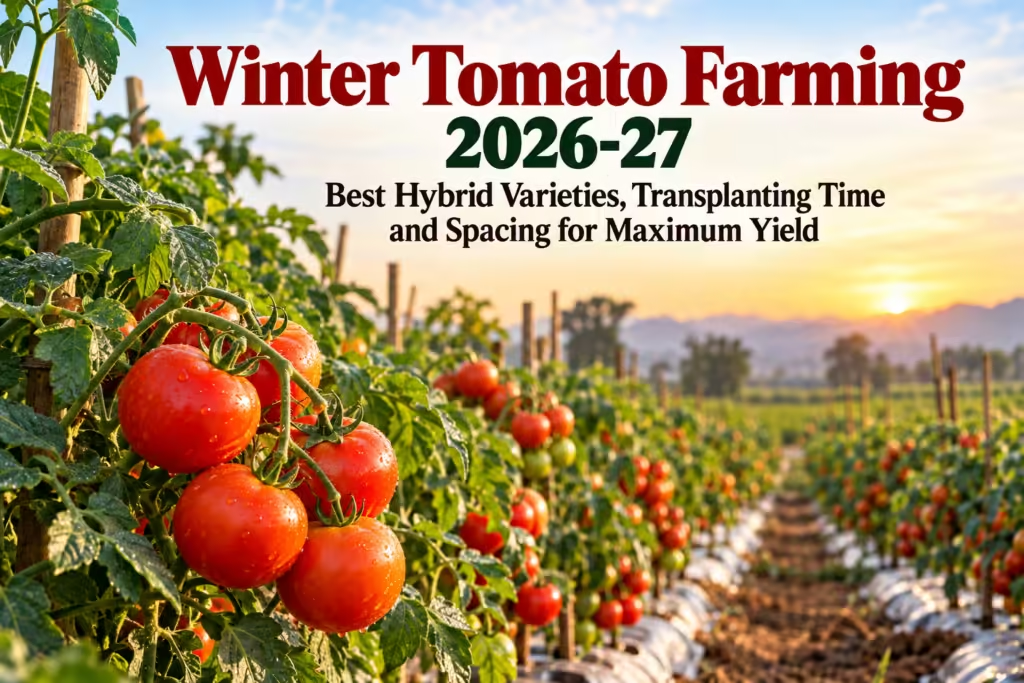
Tomato is one of the most widely grown and most traded vegetable crops in India, and the winter crop is where many farmers make their best money. Cool, clear weather suits fruit set, colour and quality, and when the crop is managed well, winter tomatoes can fetch strong prices from December to March.
But winter tomato is not an easy crop. Frost, cold nights, blight diseases and wrong spacing cause heavy losses every year. The good news is that most of these problems can be avoided with the right hybrid, the right transplanting date and a few simple practices. This guide walks you through everything for the 2026-27 season.
Why Winter Tomato Is a Profitable Crop
- Better fruit quality: Cool days and cool nights improve colour, firmness and shelf life.
- Steady market demand: Tomato is a daily-use vegetable, so there is demand in every mandi, every month.
- Good return per acre: With a good hybrid and proper staking and care, returns per acre are much higher than most field crops.
- Long picking period: A single crop can be harvested over several weeks, which spreads your market risk.
- Hybrid advantage: F1 hybrids give higher yield, uniform fruit, better disease tolerance and longer shelf life than open-pollinated varieties.
Read More: Watermelon & Muskmelon Farming 2027: Hybrid Varieties, Spacing and Timing for Maximum Yield
Best Transplanting Time for Winter Tomato in India
Tomato grows best between about 20 and 27 degrees C. Fruit set drops sharply when night temperatures fall below about 10 to 12 degrees C, and frost can kill the crop. So timing and frost protection decide your success.
Region | Nursery sowing | Transplanting | Notes |
North India plains (Punjab, Haryana, Delhi NCR, UP) | September to mid October | October to mid November | Frost risk in December and January, so protect the crop |
North India, spring-summer crop | December to January | January to February | Use nursery protection against cold |
Central India (MP, Chhattisgarh, Maharashtra, Gujarat) | September to November | October to December | Mild winters suit the crop well |
East India (Bihar, Jharkhand, West Bengal, Odisha) | September to October | October to November | Watch for humidity and blight |
South India (Karnataka, Andhra Pradesh, Telangana, Tamil Nadu) | Almost year-round with irrigation | Choose by local market window | Choose heat-tolerant types for hot months |
These are general windows. Local weather varies, so confirm dates with your nearest Krishi Vigyan Kendra (KVK) or state agriculture department.
Planning tip: Seedlings take about 25 to 30 days in the nursery. Count backwards from your planned transplanting date and order seed at least a week before nursery sowing.
How to Choose the Right Hybrid Tomato Variety
Your variety choice decides your yield, your market price and your disease risk. Look at these points before buying seed:
- Growth habit: Determinate hybrids grow to a fixed height, ripen together and suit open-field cultivation with less labour. Indeterminate hybrids keep growing, need staking and give a longer picking period and often higher total yield.
- Fruit shape and size: Round, firm, medium-to-large fruit (70 to 120 g) suits most mandi markets. Plum or oval types suit processing and transport.
- Firmness and shelf life: Firm fruit travels farther and loses less in the market.
- Disease tolerance: Look for tolerance to Fusarium wilt, bacterial wilt, leaf curl virus and nematodes.
- Fruit set in cold and heat: Winter hybrids should set fruit reliably in cooler temperatures.
- Your market: Ask local traders what size, colour and firmness they prefer before you decide.
Platinum Seeds Tomato Hybrids
Platinum Seeds offers F1 hybrid tomato seed selected for Indian growing conditions. Every variety carries Government of India GOT clearance and is tested for genetic purity, physical purity and germination.
Variety | Growth habit | Fruit type and shape | Average fruit weight | First picking after transplanting | Best suited for |
[Tomato Variety 1 name] | [Determinate / Indeterminate] | [e.g. round, deep red, firm] | [g] | [days] | [e.g. mandi supply, open field] |
[Tomato Variety 2 name] | [habit] | [type] | [g] | [days] | [use] |
[Tomato Variety 3 name] | [habit] | [type] | [g] | [days] | [use] |
Cherry Tomato
If you grow for premium or niche markets such as hotels, supermarkets and salad buyers, cherry tomato is worth a trial plot. It sells at a much higher price per kilo and suits staking and drip irrigation well.
Variety | Growth habit | Fruit type | Average fruit weight | Best suited for |
[Cherry Tomato name] | [habit] | [e.g. red, round, sweet] | [g] | [e.g. premium market] |
Explore the full range on our Vegetable Seeds page, see our F1 Hybrid Vegetable Seeds, or download the Platinum Seeds Catalogue.
Soil and Field Preparation
- Soil: Well-drained loam or sandy loam rich in organic matter, with a pH between 6.0 and 7.0, is ideal. Avoid waterlogged or heavy clay fields.
- Ploughing: Give 2 to 3 deep ploughings and harrow to a fine tilth.
- Organic matter: Mix well-rotted farmyard manure (FYM) at about 8 to 10 tonnes per acre before the last ploughing.
- Raised beds: Prepare raised beds about 3 to 4 inches high (or ridges) for better drainage and root health.
- Crop rotation: Avoid planting tomato, brinjal, chilli or potato in the same field in consecutive seasons. Rotate with cereals or legumes to reduce wilt and nematode problems.
- Soil test: A soil test before the season tells you exactly what your field needs and saves money on fertiliser.
Nursery Raising: The Foundation of a Healthy Crop
Strong seedlings give a strong crop. Hybrid seed is valuable, so a good nursery is worth the effort.
- Media: Use portrays (protrays) filled with cocopeat, or well-prepared raised nursery beds with sieved soil, sand and compost.
- Seed rate: Hybrid seed needs about 80 to 100 g per acre as a rough guide. Always follow the packet recommendation.
- Seed treatment: Treat seed with a recommended fungicide such as thiram or carbendazim as per label dose.
- Sowing: Sow one seed per cell at a depth of about 1 cm and cover lightly.
- Protection: Cover the nursery with a fine insect-proof net (40 to 50 mesh) to block whitefly and aphids, which spread viruses. In cold areas, use a low tunnel at night.
- Watering: Water lightly and regularly. Avoid overwatering to prevent damping off.
- Hardening: About 4 to 5 days before transplanting, reduce watering and expose seedlings gradually to full sun.
Seedlings are ready when they are about 20 to 25 cm tall with 4 to 5 true leaves, usually 25 to 30 days after sowing.
Damping-off alert: If seedlings collapse at the base in the first two weeks, it is likely damping off. Prevent it with clean media, seed treatment, good drainage and a preventive fungicide drench as recommended.
Spacing: Getting It Right for Maximum Yield
Spacing affects light, air flow, disease pressure and total yield. Too close and you get a damp canopy full of blight. Too wide and you waste land.
Type | Row-to-row | Plant-to-plant | Approx. plants per acre |
Determinate hybrid (open field, no staking) | 75 to 90 cm (2.5 to 3 ft) | 45 to 60 cm (1.5 to 2 ft) | 7,500 to 12,000 |
Determinate hybrid (closer, with staking) | 60 to 75 cm (2 to 2.5 ft) | 45 cm (1.5 ft) | 12,000 to 15,000 |
Indeterminate hybrid (staked, single or double stem) | 90 to 120 cm (3 to 4 ft) | 45 to 60 cm (1.5 to 2 ft) | 5,500 to 10,000 |
Cherry tomato (staked or trellised) | 90 to 120 cm (3 to 4 ft) | 40 to 50 cm (1.3 to 1.6 ft) | 6,500 to 11,000 |
Pro tip: Transplant in the evening, irrigate lightly right after planting, and plant seedlings slightly deeper than they were in the nursery. Tomato forms extra roots along the buried stem.
Read More: पशुओं के लिए हरा चारा उगाना: प्लेटिनम सीड्स परेनियल राई ग्रास किसानों के लिए कैसे उपयोगी है
Staking and Pruning
Staking is one of the biggest yield boosters, especially for indeterminate hybrids.
- Staking: Use bamboo sticks or wire and jute twine to support plants. It keeps fruit off the ground, reduces rot and makes picking faster.
- Pruning: Remove side shoots (suckers) from indeterminate types weekly and train to one or two main stems.
- Lower leaves: Remove yellow or diseased lower leaves to improve air flow.
Irrigation Management
- After transplanting: Irrigate immediately, then give light irrigation every 3 to 5 days until plants establish.
- Winter schedule: After establishment, irrigate roughly every 7 to 10 days depending on soil type and weather.
- Flowering and fruit set: Avoid water stress. Dry spells followed by heavy watering cause flower drop and fruit cracking.
- Steady moisture: Keep soil evenly moist during fruit development. Uneven watering is a main cause of blossom end rot and cracking.
- Avoid overhead irrigation: Wet leaves in cold weather invite late blight and other leaf diseases.
Drip irrigation with plastic mulch is strongly recommended. It saves water, reduces weeds, keeps fruit clean, lowers disease and lets you apply fertiliser through the system (fertigation).
Nutrient Management
The amounts below are a general guide. Adjust according to your soil test.
Stage | What to apply |
Basal (at field preparation) | FYM, full dose of phosphorus and potash, and about one-third of nitrogen |
25 to 30 days after transplanting | Second dose of nitrogen |
45 to 50 days (flowering and early fruit set) | Remaining nitrogen, with extra potash to improve fruit size and colour |
A total of roughly 50 to 60 kg nitrogen, 25 to 30 kg phosphorus and 25 to 30 kg potash per acre is a common starting point for hybrids. Calcium and boron help fruit set and reduce blossom end rot and cracking. Avoid over-feeding nitrogen late, since it produces lots of leaf and few fruits.
Protecting the Crop from Frost and Cold
Frost is the biggest winter risk for tomato in North India. Simple steps can save your crop:
- Light irrigation: Irrigate lightly in the evening when a cold wave or frost is forecast. Wet soil holds heat better than dry soil.
- Mulch: Plastic or straw mulch helps keep root-zone temperature stable.
- Windbreaks: Plant a windbreak on the north and west side, or use temporary screens.
- Covers: Use low tunnels or non-woven covers on young plants during severe cold nights.
- Smoke: In open fields, light smoke on frosty nights can help reduce frost damage when done safely.
Major Diseases and Pests, and How to Manage Them
Problem | Symptoms | Prevention and management |
Damping off (nursery) | Seedlings collapse at base | Clean media, seed treatment, good drainage, preventive drench |
Early blight | Dark rings (target spots) on older leaves | Rotation, remove infected leaves, protective fungicide |
Late blight | Water-soaked patches on leaves and fruit in cool, humid weather | Avoid overhead irrigation, good spacing, preventive sprays before cool humid spells |
Fusarium and bacterial wilt | Sudden wilting even with moist soil | Rotation, resistant hybrids, healthy seedlings, well-drained beds |
Leaf curl virus | Curled, small, yellowing leaves, stunted plants | Net-covered nursery, control whitefly, yellow sticky traps, tolerant hybrids |
Fruit borer (Helicoverpa) | Holes in fruit, caterpillars inside | Pheromone traps, remove damaged fruit, recommended insecticide |
Leaf miner / Tuta absoluta | Silvery mines in leaves, damaged fruit | Early monitoring, pheromone traps, recommended control |
Blossom end rot | Dark sunken patch at fruit base | Steady irrigation, calcium supply |
Fruit cracking | Splits around fruit shoulder | Steady moisture, boron, suitable hybrid |
Always read label instructions and use only recommended chemicals. Choosing a tolerant hybrid from the start is the cheapest and most effective protection. Read more in our guide on disease-resistant vegetable seed varieties.
Harvesting and Marketing
- First picking: Usually begins about 60 to 90 days after transplanting, depending on the hybrid and weather.
- Picking stage: For distant markets, pick at the breaker stage (first colour change) so fruit stays firm in transit. For local markets, pick when fruit is pink to red.
- Frequency: Pick every 3 to 5 days. Regular picking keeps plants productive.
- Handling: Pick in the cool part of the day, handle gently and use clean crates. Avoid piling fruit too high.
- Grading: Sort by size and colour. Graded fruit gets better prices.
Expected Yield
Yield depends on variety, season, spacing, staking and management. Under good management, determinate hybrids in open field commonly give around 15 to 25 tonnes per acre, and staked indeterminate hybrids can give more. Mandi prices vary widely by season and region, so check current local rates before planning.
9 Common Mistakes That Reduce Tomato Yield
- Using weak, unhardened or virus-infected seedlings.
- Transplanting too late into peak cold or too early into heat.
- Planting too closely, which creates a humid canopy and blight.
- Skipping staking for indeterminate hybrids.
- Growing tomato in the same field year after year.
- Irregular irrigation, causing cracking and blossom end rot.
- Over-applying nitrogen and under-applying potash and calcium.
- Ignoring whitefly control in the nursery and early crop.
- Using low-quality, uncertified or untested seed.
Why Farmers Trust Platinum Seeds for Tomato Hybrids
With more than 65 years of experience across three generations, Platinum Seeds understands what Indian farmers need: seed that germinates reliably, grows uniformly and delivers market-ready fruit.
- GOT-cleared seed: Government of India GOT clearances on all products.
- Tested quality: Every lot is tested for genetic purity, physical purity and germination.
- Hybrid performance: F1 hybrids selected for yield, firmness and disease tolerance.
- Farmer-friendly pricing: Competitive rates with a no-questions-asked return policy.
- Pan-India reach: Offices in Delhi and Bangalore, serving farmers across all states.
Not sure how to choose quality seed? Read our guide on how to choose the best quality seeds for farming in India.
Read More: सजावटी खेती बनाम पारंपरिक फसल खेती: भारतीय किसानों के लिए कौन-सा बेहतर है?
Get Your Tomato Seeds Ready for the Winter Season
A strong tomato crop starts with good seed and a healthy nursery. Place your order early so your hybrid is in hand before nursery sowing.
- Call or WhatsApp: +91 99998 07771
- Email: Platinumseeds@hotmail.com
- Browse seeds: platinumseeds.in/vegetable-seeds
- Contact page: platinumseeds.in/platinum-seeds-contact
Platinum Seeds: Be Irreplaceable.
Frequently Asked Questions
What is the best time to transplant tomato in winter in North India?
In most North Indian plains, October to mid November is the usual window for the main winter crop, with nursery sowing from September to mid October. In frost-prone areas, protect the crop or plan a January to February transplanting instead.
How much seed is needed per acre for hybrid tomato?
Roughly 80 to 100 g per acre depending on the hybrid. Always follow the packet recommendation.
What is the ideal spacing for tomato?
For determinate hybrids, 75 to 90 cm between rows and 45 to 60 cm between plants. For staked indeterminate hybrids, 90 to 120 cm between rows and 45 to 60 cm between plants.
How many days does tomato take from transplanting to first harvest?
Usually about 60 to 90 days, depending on the hybrid and weather.
Should I choose determinate or indeterminate tomato?
Determinate suits open-field farmers who want less labour and a concentrated harvest. Indeterminate suits farmers who can stake and want a longer picking period and higher total yield.
How do I protect tomato from frost?
Use light evening irrigation, mulch, windbreaks, and covers or low tunnels on very cold nights, especially for young plants.
Why do tomato flowers drop in winter?
Cold nights below about 10 to 12 degrees C, water stress and nutrient imbalance can all cause flower drop. Choose hybrids that set fruit well in cool weather and keep irrigation steady.
Where can I buy Platinum Seeds hybrid tomato seeds?
You can order from our Shop, download the catalogue, or contact us directly on +91 99998 07771. We also supply dealers and distributors.
Disclaimer: Sowing dates, seed rates, fertiliser doses and spray recommendations in this article are general guidelines. Conditions differ by region and farm. Please consult your local KVK or agriculture officer and follow product label instructions.