
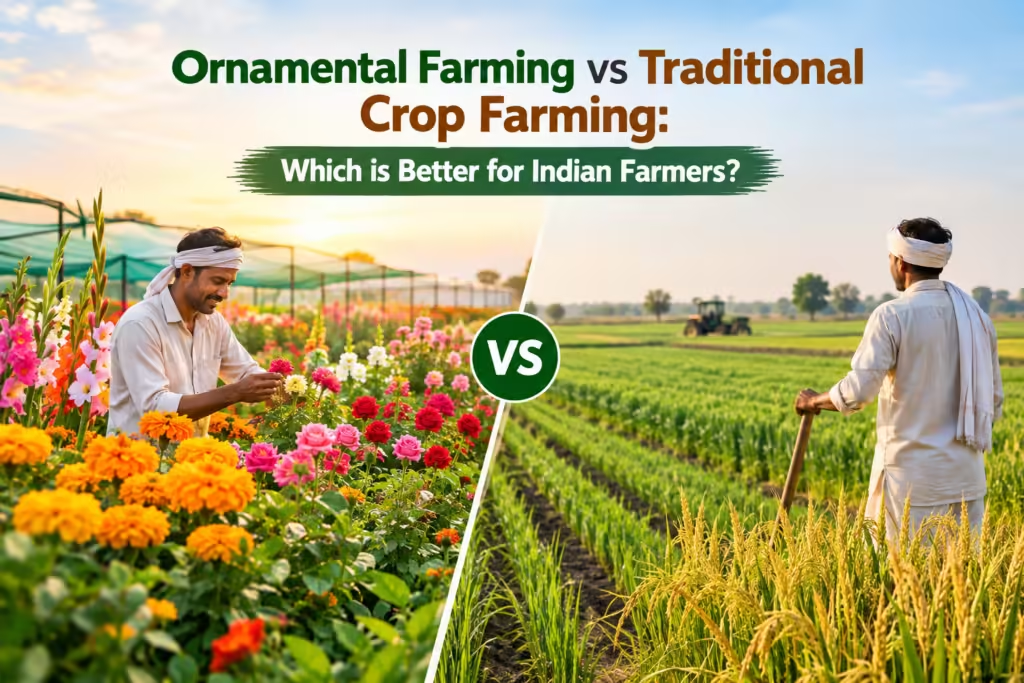
Every farmer eventually asks the same question: should I stick with traditional crops like wheat, rice, and sugarcane, or should I switch to something new like ornamental flower farming? Both paths have their own risks and rewards. In this guide, we break down the real differences so you can make an informed decision for your land, budget, and market.
What is Ornamental Farming?
Ornamental farming means growing plants primarily for their beauty and decorative value — flowers like marigold, rose, gladiolus, tuberose (rajnigandha), chrysanthemum, and various ornamental grasses and foliage plants. These are sold for weddings, festivals, temples, home decor, landscaping, and export markets, rather than for food.
Read More: F1 हाइब्रिड भिंडी की किस्में 2026: अधिक उपज वाली भिंडी की खेती की पूरी गाइड
What is Traditional Crop Farming?
Traditional farming refers to the cultivation of staple crops — wheat, rice, sugarcane, pulses, cotton, and similar food or cash crops that have been grown across Indian farmland for generations. These crops feed the nation and form the backbone of the Public Distribution System (PDS) and mandi trade.
Side-by-Side Comparison
Factor | Ornamental Farming | Traditional Crop Farming |
Initial Investment | Moderate to high (seeds, polyhouse, irrigation) | Low to moderate (widely available seeds and subsidies) |
Profit Margin | High per acre, especially during festival/wedding season | Stable but generally lower margin per acre |
Market Demand | Seasonal spikes (festivals, weddings, Valentine’s Day) | Consistent, government-backed demand (MSP) |
Price Stability | Volatile — depends on demand and perishability | More stable due to Minimum Support Price (MSP) |
Water Requirement | Often lower for many flower varieties | High for crops like rice and sugarcane |
Storage & Shelf Life | Very short — flowers are highly perishable | Long — grains can be stored for months |
Government Support | Growing support (National Horticulture Mission) | Strong, well-established (MSP, PDS, crop insurance) |
Labor Requirement | Often labor-intensive (harvesting, packing) | Mechanized options widely available |
Market Access | Needs direct buyers, florists, or export tie-ups | Established mandi and procurement system |
Risk Level | Higher risk, higher reward | Lower risk, predictable returns |
Advantages of Ornamental Farming
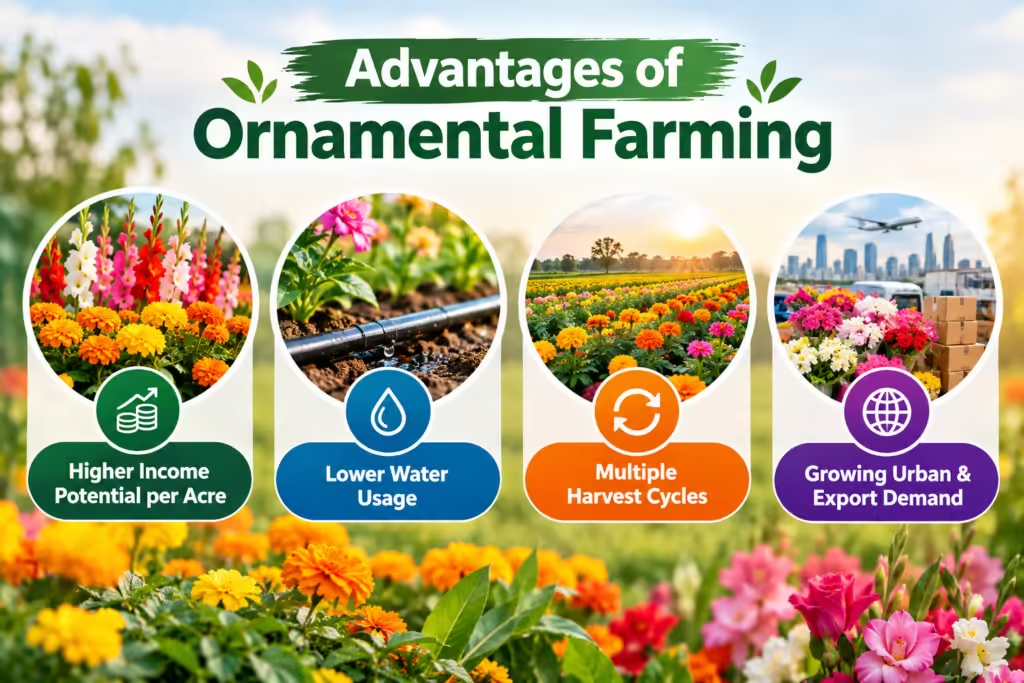
- Higher income potential per acre Flowers like marigold and gladiolus can generate significantly more revenue per acre compared to wheat or rice, especially when timed around festivals like Diwali, Dussehra, or wedding season.
- Lower water usage for many varieties Several ornamental crops need less irrigation than water-guzzling crops like paddy, making them a good fit for water-stressed regions.
- Multiple harvest cycles Many flowers can be harvested multiple times in a single season, unlike traditional crops that usually offer one or two harvests a year.
- Growing urban and export demand With rising urbanization, demand for cut flowers, landscaping plants, and nursery products is increasing steadily in Indian cities and abroad.
Challenges of Ornamental Farming
- Perishability: Flowers wilt fast, so farmers need quick access to markets or cold storage.
- Price volatility: Prices can crash after major festivals due to oversupply.
- Limited government safety net: Unlike wheat or rice, there’s no MSP for ornamental crops.
- Market knowledge required: Farmers need buyer connections in cities, mandis, or export channels — not just a mandi ticket.
Read More: Growing Green Fodder for Livestock: How Platinum Seeds Perennial Rye Grass Can Help Farmers
Advantages of Traditional Crop Farming
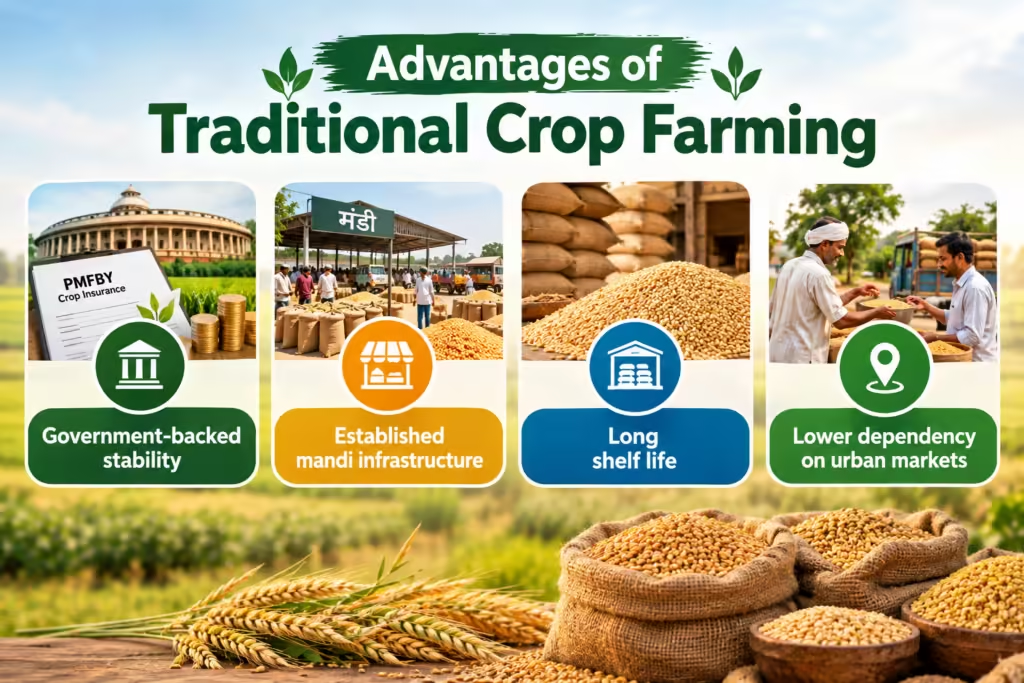
- Government-backed stability MSP, crop insurance (PMFBY), and a well-established procurement system make traditional farming lower-risk.
- Established mandi infrastructure Every district has functioning mandis for grains, reducing the need for farmers to find buyers themselves.
- Long shelf life Grains can be stored for months, giving farmers flexibility to sell when prices are favorable.
- Lower dependency on urban markets Traditional crops can be sold locally without needing city-based buyers or cold chain logistics.
Challenges of Traditional Crop Farming
- Lower profit margins per acre compared to high-value ornamental crops
- High water consumption, especially for paddy and sugarcane
- Soil degradation from continuous monocropping
- Rising input costs (fertilizer, diesel, labor) squeezing net profits
So, Which One Should You Choose?
There’s no one-size-fits-all answer — it depends on your land size, water availability, market access, and risk appetite.
Choose ornamental farming if:
- You’re near a city or have good transport access to flower markets
- You can invest in some infrastructure (shade net, irrigation)
- You’re willing to take on more risk for higher potential returns
- You have access to buyers, florists, or export contacts
Stick with traditional farming if:
- You depend on MSP and government procurement for income stability
- Your land is far from urban markets
- You prefer lower risk and predictable, if modest, returns
- Water availability supports crops like wheat or pulses better than flowers
The smartest approach for many farmers is a hybrid model — dedicating a portion of land to ornamental crops for extra income while continuing traditional farming on the rest. This way, you get the stability of MSP-backed crops along with the higher profit potential of flower farming, without betting your entire livelihood on one option.
Read More: F1 Hybrid Okra Varieties 2026: A Complete High-Yield Bhindi Farming Guide
Final Thoughts
Ornamental farming isn’t a replacement for traditional agriculture — it’s an opportunity to diversify. Indian farmers who test ornamental crops on a small plot first, understand their local flower demand, and build buyer relationships before scaling up tend to see the best results. Whichever path you choose, start small, track your costs and returns carefully, and grow based on what actually works for your land and local market.